
Critical Incident Response Guide
Initial Focus of Effort
Initial Focus of Effort
- Prevent loss of Life or great bodily injury
- Determine what Response/Resources are appropriate for the incident
- Contain the event
- Isolate the event
- Evacuate all uninvolved parties
- Gather, verify and disseminate Intelligence information
- Gather/Protect all materials (evidence) for justification/prosecution
- Provide for Human Needs
- Develop Contingency Plans
Framing an Operation/Incident
- What do I have (Frame the Incident)?
- What is Familiar or Unfamiliar?
- What are the anomalies?
- What do I want to have happen (End State/Objectives/Commanders Intent)?
- Who/What do I want it to happen to (Focus of Effort)?
- How, When and Where do I want it to happen (Tactics/Time/Terrain)?
- What are my contingency plans?
- What do I NOT want to happen?
NOTE: Constantly reassess the incident as the circumstances change or evolve. Don’t get anchored into your first plan of action. Know that every action you take, changes the situation and you must make the necessary changes to adapt. Example: Hostage situation where the hostage escapes leaving the suspect by himself/herself. This should now be treated as a barricaded suspect.
Cynefin Framework
- Clear/Simple/Obvious: Sense, Categorize, Respond (Best Practice)
- Complicated: Sense, Analyze, Respond (Good Practice)
- Complex: Probe, Sense, Respond (Heuristics/Rules of Thumb/Safe to Fail Experiments)
- Chaotic: Act, Sense, Respond (Do something to put the problem in anther domain. No Constraints)
Air Crashes
CLICK TO OPEN CHECKLIST
Objectives:
Police responsibilities include the preservation of life, protection of property and to provide assistance to NTSB and the FAA during the scope of their investigation. In depth aircraft accident investigations are usually not necessary by local law enforcement agencies and can sometimes compromise the FAA/NTSB accident investigation process. Police personnel will assist with tasks such as evacuations, traffic control, crowd control, crime scene (crash site) preservation, and security. Law Enforcement personnel should use extreme caution around the downed aircraft, realizing that there are hazmat, biohazard, chemical, explosives, radioactive, highly flammable oxygen, compressed air, flares, and ballistic parachute systems that could pose extreme hazards to first responders. DO NOT APPROACH THE DOWNED AIRCRAFT UNLESS LIFE-SAVING MEASURES ARE REQUIRED
Initial Response:
- Situation Assessment for NTSB/FAA should contain:
- Location of the accident
- Size of the involved area, actual and potential
- Type of structures involved (if applicable)
- Type of area (business, residential, hillside, etc.)
- Number of injuries and/or deaths
- Military or Civilian Aircraft
- Type of aircraft (cargo, passenger, helicopter)
- Class of aircraft (single engine, multi, jet)
RESOURCE PHONE NUMBERS (Notifications):
- NTSB Comm Center: (202)314-6290
- NTSB Main Number: (202) 314-6000
- FAA Regional Comm Center: (206)231-2099
- Ballistic Parachute Info: Cirrus-(800)279-4322
Active Shooter
CLICK TO OPEN CHECKLIST
Objective:
The Primary objective of any Active Shooter incident is to immediately stop the threat (STOP THE KILLING/STOP THE DYING). Once the threat has been neutralized or determined not to be at the location, Police and Fire personnel should work together to affect rescues of downed victims or individuals that have sheltered in place. Additional considerations should include the preservation of the crime scene, identification of witnesses, and reunification of the victim(s) with their families. The key to handling a large scale incident such as this is to delegate tasks to entrusted personnel.
Statistical Information (2000-2010):
To assist in decision making (helpful hints), here are some salient points that have been learned from past active shooter incidents (approximately 110 active shooter events):
98% were single shooters (lone wolfs)
94% were males
55% had a connection with the attack location (intelligence in identifying shooter)
59% used pistols
26% used rifles
8% used shotguns
5% had body armor
3% had explosive devices
Notifications:
- Watch Commander
- Command Staff
- SWAT
- Fire Department
- PIO (media and social media)
- Air Support
- Detective Personnel
- Forensics
Resources To Consider:
- Bearcat/Medcat
- K9
- Traffic Bureau
- Mutual Aid
- Red Cross
- Mass Transit: Buses…
- Portable Restrooms
- Bomb Squad (if devices are located)
- Cadets/Explorers (Staging area, scribes, Traffic Control, etc.)
Assist Fire/Unified Command
CLICK TO OPEN CHECKLIST
Objective:
Police responsibilities will vary depending on the scale and severity of the fire or incident. The primary role of law
enforcement is to support the fire department and other responding agencies by providing evacuations, traffic management, crowd control, looting suppression, intelligence gathering, and scene security.
Initial Response:
- Situation Assessment for Fire Should Contain:
- Location of incident
- Size of involved area, actual and potential
- Apparent direction of the fire
- Type of area (business, residential, hillside, etc.)
- Ingress/Egress routes for emergency vehicles
- Location of Command Post (may be moved by fire later)
- Location of Staging Area
- Number of Victims
Note: Law enforcement cannot make residents evacuate their properties. If occupants refuse to evacuate, document their name(s) and move on. Notify the Command Post of the location of the refused parties, how many people are staying, and which officer/firefighter made the advisement.
Barricaded Suspect(s) Patrol
CLICK TO OPEN CHECKLIST
Objective:
To safely effect the arrest of a suspect (or suspects) who has barricaded themselves
in a residence, business, vehicle, or other position of advantage. A barricaded
suspect requiring a SWAT response is defined by the following criteria:
- The suspect is armed or is reasonably believed to be armed; and
- The suspect is believed to have committed a criminal act or poses a significant threat to the lives and safety of citizens and/or police; and
- The suspect is in a position of advantage (cover, concealment, or fortification), or is contained in an open area where the presence or approach of officers could
trigger violence; and - The suspect refuses to submit to arrest.
When these criteria are met, the Incident Commander shall immediately request
a SWAT response.
Once these criteria are met, the Incident Commander should immediately request SWAT to respond.
When requesting SWAT, be prepared to ask the following questions:
- What is the situation? (detailed brief)
- Are there any hostages?
- Have shots been fired? Weapon Type?
- Is the suspect contained? How do you know? Do containment officers have proper cover/concealment?
- Has the suspect been asked to surrender?
- Is the affected area isolated? (Evacuations)
- What is the safest route to approach the Incident Command Post?
- If possible, get diagram/photo of location
Notifications:
- Command Staff
- SWAT / CNT
- PIO
- Air Support
- Detective Personnel
DISENGAGEMENT CONSIDERATIONS
- Suspect is Suicidal, did not commit a crime, and is not a threat to the public or others
- Suspect has been identified and is not a threat to the public (follow up with Detectives)
- Victims/Involved Parties are able to temporarily relocate
- Risk to officers outweighs the benefit of immediate resolution
- The surveillance team is available to monitor
- Resources are not available to resolve the incident
Bomb Threat
CLICK TO OPEN CHECKLIST
Objectives:
To ensure the safety of all personnel / residents in the danger zone by means of establishing a perimeter and determining whether or not evacuations are necessary. Law enforcement personnel will also conduct an investigation to determine the source of the threat.
Initial Response:
- Contact the person in charge of the facility that is the target of the threat to determine whether or not they wish to evacuate the premises.
- Obtain information from people at the location to determine if the threat is credible.
- Establish a perimeter of at least 300 feet.
- Attempt to locate a device. Notify your local Bomb Squad if device is located.
Questions to ask person making threat:
- When is bomb going to explode?
- Where is the bomb right now?
- What kind of bomb is it?
- What does it look like?
- Why did you place the bomb?
Record the time of call, exact words suspect used, age, sex, speech patterns or accents, and any background noises.
If a threat occurs at your police station, search for the device, evacuate station if found (to include the jail if credible). Dispatch efforts should continue unless unsafe to do so. Consider relocating to dispatch to alternate dispatch sight if device is located.
Bomb Threat Flowchart
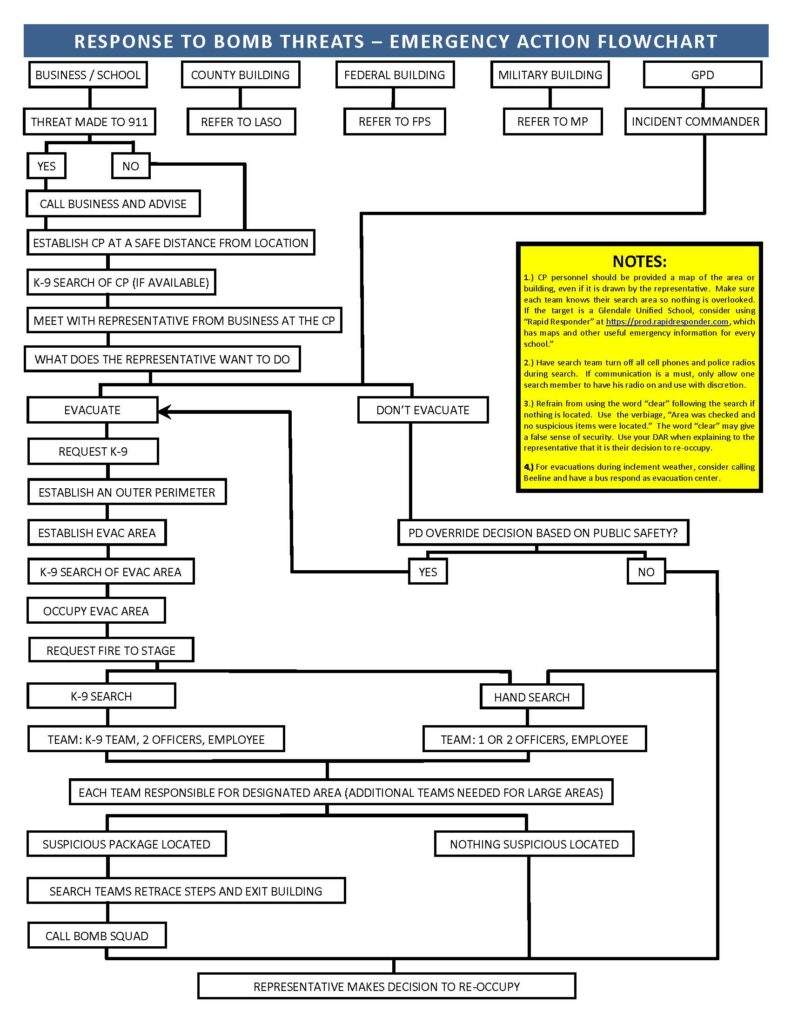
Click to Enlarge
Command Post
CLICK TO OPEN CHECKLIST
Location Selection
- Proximity: Close enough for oversight, far enough for safety; place CP within the outer perimeter but outside the inner perimeter.
- Accessibility: Ensure the CP is easy to reach, with clear ingress and egress routes for responding units.
- Security: Position in a secure area, minimizing risk from threats, interference, or hazards.
- Perimeter Security: Establish a controlled perimeter; restrict access to essential personnel only.
- Adversarial Considerations: For high-risk events, select a CP lo cation at least two turns away to reduce visibility and threat exposure.
- Space: Provide adequate room for staff, equipment, communications, and separate areas for media if required.
- Power and Connectivity: Ensure reliable power and communications; have backup power available.
- Environmental Controls: Select a location sheltered from weather; plan for heating, cooling, or portable shelters if necessary.
- Restrooms: Choose a site near restrooms; if unavailable, bring in portable restrooms for extended operations.
- Media Coordination: Designate a PIO and separate media staging area away from the CP and out of line of sight.
Critical Incident Response (Initial)
CLICK TO OPEN CHECKLIST
Initial CIR:
- Establish Command / Command Post
- Identify Location of Incident
- Identify Crime that Occurred / Legal Authority
- Establish Inner / Outer Perimeter
- Containment
- Deploy Patrol Rifle Personnel
- Develop a REACT team
- Consider Evacuations
- Identify Radio Channel for Incident- Conduct Roll Call
- Unified Command / Stage Fire / Casualty Collection Point
- Broadcast Description of Suspect
- Ingress / Egress routes for emergency vehicles
- Notify Chain of Command
- Notify Investigative Services (Detective Response / Search Warrant)
- Gather intelligence on Suspect / Location
- Consider using Traffic personnel for Outer Perimeter / Crowd Control
- Consider Specialized Details
- Mutual Aid Notification if additional personnel are needed
- Identify Press Staging area / Notify PIO
- Social Media Blast Advising Community
- Update personnel over the radio every 30 minutes
Crowd Control/Riot/
Rules of Engagement
Chemical Munitions/Agent Deployment
CLICK TO OPEN CHECKLIST
Objectives:
Modern day usage of chemical munitions will generally fall under one of 5 usages:
- Disperse crowds (unlawful assemblies)
- Dislodge Barricaded Suspect(s)
- Distract individuals
- Disorient individuals
- Detect suspects that are hiding.
This checklist is designed to assist law enforcement prior to, during and after chemical munitions are deployed.
The two types of chemical agents commonly used by the Glendale Police Department consist of Ortho-Chlorobenzalmalononitrile (CS) and Oleoresin-Capsicum (OC). Delivery options include, but are not limited to:
- Projectiles (ferrets, pepper balls, 40mm direct impact)
- Instantaneous blast grenades
- Pyrotechnic grenades
- Aerosol
- OC Vapor Grenades
Quantity of Agent in Munitions:
40mm liquid ferret round
8 grams CS gas
Maximum effective range 50 yards
Tri Chamber Flameless grenade
20 grams CS gas
Does not need to be in a delivery device
Indoor/outdoor use
Riot Control CS
75 grams CS gas
Burn safe for indoor use
Flammable (200F-800F)
Pocket Tactical CS
25.2 grams CS gas
Flammable (200F-800F)
Crowd Control/Riot (MFF)
CLICK TO OPEN CHECKLIST
Objective:
The Primary Mission of the Department when responding to the scene of a lawful assembly is to preserve public order while at the same time protecting the Constitutional Rights of individuals involved. The department should strive to restore conditions to normal as rapidly and efficiently as possible. Objectives that must be addressed to accomplish this include:
- Protection of life
- Protection of vital facilities
- Arrest Violators
- Restore and Maintain Order
- Protect Property
The objectives that must be addressed to accomplish this mission are (in priority order):
- Establish contact with the crowd and make contact with the formal leader or event organizer(s) if possible.
- Obtain voluntary compliance with police directives.
- Minimize enforcement action.
Notifications:
- Watch Commander
- Command Staff
- SWAT
- Fire Department
- PIO (media and social media)
- Air Support
- Detective Personnel
- Forensics
Resources to Consider:
- SWAT (QRF)/Bearcat/Medcat
- Mobile Field Force/QRT’s
- Traffic Bureau
- Mutual Aid
- PIO (media and social media)
- Red Cross
- Mass Transit/Busses
- Portable Restrooms
- Bomb Squad (if devices are located)
- Cadets/Explorers (Staging area, scribes, Traffic Control, video etc.)
Pre-Operation:
- Develop an Incident Action Plan
- Consider using explosive detection K9’s to sweep area of protest
- Identify MFF Platoons, Quick Reaction Teams, Video personnel, Grenadiers etc.
- Small agile QRT’s are designed to target areas of violence/property damage; make contact with criminals/Looters (arrests).
- Ensure “Unlawful Assembly Orders” are prepared in all appropriate languages
- Consider sweeping the area with LPR technology
- Ensure all vehicles are fueled and equipped for rapid deployment. Keep vehicles out of sight and in an area that is protected.
- Identify Procedures and Personnel for a “Mass Arrests and Bookings”
- Location
- Security / Over Watch
- Prisoner’s Property
- Transportation
- Arresting Officer/Booking Officer procedures
- Phone Calls
- Special Needs, Medical personnel, Segregation
- Arrange food, water and restrooms for personnel.
- Send out a “Mutual Aid” Notification to Area C personnel
- Consider resources from Vital Medical, Tow Truck Companies, Red Cross, Hospitals, the Fire Department, and Public Works.
Dispersal Order:
Dispersal order sample
I am (Commanding officers name) and I represent the (Department). I hereby declare this to be an unlawful assembly per Penal Code Section 407, and, in the name of the People of the State of California, I command all those assembled at (Frame the physical location) to immediately disperse, which means to break up this assembly and leave the area.
(If the crowd is violent or violence is imminent)
If you do not do so, you may be arrested or subject to other law enforcement action. Other law enforcement action could include the use of force which may inflict significant pain or result in serious injury.
If you do not disperse, you will be arrested for Penal Code section 409 (Refusing to disperse) and Penal Code section 416 (Remaining present at an unlawful assembly). If arrested, do not resist arrest. Credentialed members of the press should move to designated safe areas at this time.
The following routes of dispersal are ___________________.
It is now___:___ AM / PM – You have _____ minutes to leave the area.
You must leave the area by ___:___ AM / PM
Post-Operation:
- Identify Master Report Writer / Case Detective (Master DR#)
- Identify Evidence Coordinator
- Ensure all uses of force are documented, even if no arrests were made
- Preserve evidence to include digital documentation, body worn camera video, cellular video, debris field material and weapons utilized by rioters.
- Utilize forensics to photograph area, injuries to officers and demonstrators.
- Obtain video from surveillance cameras (residences/businesses) where the riot/protest occurred.
- Ensure all personnel are provided with medical care / mental health referrals. Document injuries and notify Worker’s Compensation.
- When feasible, conduct a debrief with all personnel involved, including protest organizers, the fire department, public works, and city government. Prepare an “After Action Debrief”
Logistics/Equipment:
- Officers:
- Helmets, Shields, Gas Masks, Batons, 40mm, Tasers, OC, DAR’s/BWC, Laser Shield
- Body Armor
- Water, Sunscreen, Food, Cold Weather Clothing
- Flex Cuffs
- Field Interview Cards
- Mobile Field Force
- Suburban with skids attached (MFF Deployment)
- Fire Extinguishing Devices
- Video Cameras
- Barriers/Police Tape (street barricades, tangle tape, road blocks etc)
- Public Address System (bull horn, Mad Haler, Digital Sign)
- Large fan for chemical agent decontamination
- Extra flex cuffs
- Transportation for Mass Booking
- Chemical Agent/Pepperball
- Sting Ball
- Noise Flash Diversion Devices
- Bolt cutters
- Closed Ear Communications (SWAT headsets)
- Flashlights/Spot lights (SWAT Equipment Truck)
- Lasers (to point out locations)
- Plastic Litter (for injured officers/citizens)
- Field Interview Cards
- Command Center
- Command Board(s)
- Lap top with Mobile Comm / JDIC / Flock
- ICS Forms
- Downlink and/or Pole Cameras
- Personnel Roster (MFF/Patrol/SWAT/QRT’s)
- Radio Call Signs
- Large printed or digital (displayed on monitors) satellite maps showing location of fixed points
- TV’s to monitor media
- Scribe
- Check in/Check Out station
- Intelligence Officer to monitor live social media feeds
Rules of Engagement (ROE)
Misdemeanor Vandalism/Property Damage
- Perimeter/Crowd Control Teams will identify violators and take appropriate enforcement action
- Without clear and compelling need, arrests shall only be made with the approval of a sergeant or above.
- You have the right to have an attorney present during questioning. Do you understand this?
Violence/Threat of Great Bodily Injury
- Perimeter/Crowd Control Teams will identify violators for arrest and/or cite on view of violation
- Absent exigent circumstances, the authority to employ less lethal force options shall be vested with a lieutenant or above, and only upon clear and compelling circumstances.
- Impact munitions should not be deployed at violent agitators who are embedded in a crowd of peaceful protestors without a clear line of site of the violent agitator. This is meant to mitigate accidental hits on peaceful protestors.
Crowd Control/Movement
- Vandalism/Violence overwhelming large fights
- The decision to declare an assembly unlawful and disperse a mob shall be made by a lieutenant or higher
- Chemical agents will be deployed only with approval of the Incident Commander. Conditions that may require the use of chemical agents include, but are not limited to:
- When mob control efforts are proving ineffective,
- The conditions have become too dangerous for officers to enter or remain in an area
- The dynamics of the mob demand immediate and forceful dispersal
Responsibilities of Team Leaders
- Ensure proper notification to the crowd is given in all languages that are appropriate. Consider visual warnings as well (digital billboards)
- Maintain the cohesion of their team
- Do not allow team members to take independent action
- Accept responsibility for team communications with the Incident Commander/Area Commander
- Advise the Incident Commander of any law violations
- Perimeter Team leaders must allow law abiding citizens who wish to leave the area an ability to exit
- Each use of force shall be fully documented, to include the rationale and description of the suspect if not arrested.
IT IS CRITICAL THAT RESPONSES ARE COORDINATED BY THE COMMANDERS AND MEMBERS ADHERE TO THOSE INSTRUCTIONS GIVEN AT THE TIME. EXCEPT UNDER EXTRAORDINARY CIRCUMSTANCES, RADIO COMMUNICATIONS WILL BE LIMITED TO COMMANDERS, TEAM LEADERS AND THE OVERWATCH.
“OFFICERS NEVER RELINQUISH THE RIGHT TO SELF DEFENSE”
Earthquake/Natural Disasters
CLICK TO OPEN CHECKLIST
Objective:
Police responsibilities will vary depending on the severity of the incident. The Fire Department and Public Utility Companies will be heavily involved in the incident. The role of the police department immediately after a quake are as follows:
- Account for Personnel (Roll Call)
- Re-establish Communications, if disrupted
- Conduct a Damage Assessment of Critical Infrastructure and Key Resources
- Open/Maintain Ingress/Egress Routes for Emergency Vehicles
- Facilitate evacuations of special needs community members
- Establish evacuation assembly points
- Provide safe, orderly alerting and evacuation
- Protect critical facilities and supplies
End State:
To restore order to the community by assisting in the response and recovery. Ensuring members in the community are safe, informed, and that laws are enforced.
Notifications:
- Chief of Police/Command Staff
- Watch Commander
- City Manager (Dec. Local Emergency)
- PIO
- County Operations
- State OES (Emergency Mutual Aid)
Elder Abuse
CLICK TO OPEN CHECKLIST
Objective:
Objective: The Department shall investigate every report of senior and disability victimization. No report shall be dismissed as merely a civil matter or for any other reason without an investigation.
Definitions:
Elder – A person who is 65 years of age or older (Welfare & Institution Code §15610.27).
Dependent Adult – Any person, regardless of whether the person lives independently, residing in this state, between 18 and 64 years of age, who has physical or mental limitations that restrict his/her ability to carry out normal activities or to protect his/her rights including, but not limited to, persons who have physical or developmental disabilities or whose physical or mental abilities have diminished because of age. This includes any person between 18 and 64 years of age who is admitted as an inpatient to a 24-hour health facility, as defined in state law (Health and Safety Code § 1250; Health and Safety Code § 1250.2; Health and Safety Code § 1250.3; Welfare & Institution Code § 15610.23).
Elder and Dependent Adult Abuse – A violation of Section 368 and includes physical abuse, neglect, financial abuse, abandonment, isolation, abduction, or other treatment with resulting physical harm, pain, or mental suffering, or the deprivation by a care custodian of goods or services that are necessary to avoid physical harm or mental suffering. This also includes any other act that would mandate notification to a social service/licensing agency or law enforcement related to the abuse of an adult (Welfare & Institutions Code § 15610.07; Welfare & Institutions Code § 15610.27; Welfare & Institutions Code § 15610.23).
Notifications:
- Watch Commander
- Detective Bureau (Assaults)
- Long Term Care Ombudsman: 1-800-334-9473 Email: ombudsman2@wiseandhealthyaging.org
- State Department of Public Health: (916) 558-1784
- Department of Justice (Bureau of Medi-Cal Fraud and Elder Abuse): (800) 722-0432 Email: dmfeaoutreach@doj.ca.gov
- State Department of Social Services: https://www.cdss.ca.gov/contact-us
- California Department of Aging: https://aging.ca.gov/Contact_Us/
- Department of State Hospitals: https://www.dsh.ca.gov/About_Us/Contact_Us.html
- DA’s Command Post/EPO Hotline:
- DA’s Office of Elder Abuse Unit
- Community Care Licensing (844) 538-8766 Email: letusno@dss.ca.gov
Hate Crimes
CLICK TO OPEN CHECKLIST
Objective:
Your department policy should be designed to meet or exceed the provisions of Penal Code 13519.6 (c). The purpose of this checklist is to provide members of this department with guidelines for identifying and investigating incidents and crimes that may be motivated by hatred or other bias.
Hate crimes are defined as a criminal act committed in whole or part, because of one or more of the following actual or perceived characteristics of the victim (Penal Code 422.55; Penal Code 422.56; Penal Code 422.57):
- Disability
- Gender
- Nationality
- Race or ethnicity
- Religion
- Sexual Orientation
- Association with a person or group with one or more
Note: The federal “Matthew Sheppard and James Byrd, Jr. Hate Crimes Prevention Act” expands federal hate crimes to include crimes motivated by a victim’s actual or perceived sex, sexual orientation, gender identity or disability (18USC 249)
Notifications:
- Watch Commander
- Command Staff
- PIO
- Detective Personnel (RHD)
High Risk Threat Matrix
CLICK TO OPEN CHECKLIST
Objective:
Law enforcement personnel are often confronted with situations that exceed the normal day-to-day threat criteria. If time allows, detectives, officers, and supervisors should assess each situation to determine the safest way to resolve the incident. Specialized units (i.e.: SWAT, K9, CNT, etc.) should be considered if items listed in this matrix apply. If checked, law enforcement personnel should consult with a SWAT team leader.
Hostage Rescue
CLICK TO OPEN CHECKLIST
Objective:
To safely rescue/recover hostages or captives, utilizing the skills of team, speed, surprise, intelligence, technology and diversion. Efforts will be made to negotiate with the hostage taker, but if a window of opportunity presents itself which would favor a successful rescue, the incident commander should consider initiating the rescue. Other items of consideration should include: the use force policy, the safety of officers affecting the rescue and legal considerations for successful prosecution.
Hostage Defined:
-A person seized or held as security for the fulfilment of a condition
Captive Defined:
-A person who has been taken prisoner (negotiations are less likely to be successful because the suspect doesn’t want anything in return)
Things to consider:
- Option to de-escalate by means of Negotiations
- REACT will be staged in the event a hasty rescue needs to be conducted.
- Long Rifle / Observer Teams will be deployed (Sniper Initiated Assault considered if other means fail)
- Evacuation of Neighboring Properties
- A “Deliberate Assault” team should be formed and a plan should be established if a planned rescue is determined to be the safest way to rescue the hostages. Practice in residences with similar floor plans if available.
- Have a team in place to recover hostages that are released/escape.
- Have a plan in place to take the suspect(s) into custody if he/she should surrender.
- Discuss what SWAT will do if:
- Shots are fired inside the location
- Shots are fired at officers
- The suspect(s) actively assaults the hostages/captives
- A fire starts inside the location
- The suspect separates from the hostages
- If window of opportunity arises, consider initiating a Hostage Rescue utilizing SPEED, SURPISE, TECHNOLOGY and DIVERSION. Consider the following:
- The likeliness of safely rescuing the Hostage(s) if SWAT initiates a rescue attempt
- If Hostage(s)/Captive(s) escape, “Jack Pot” will be aired to all SWAT personnel and the situation will be treated like a “Barricaded Suspect”
- Was the suspect(s) open to negotiations/communication
- The layout of the property and fortifications
- The location of the suspect/hostages (stealth probe to contact)
- Type of weapon(s) the suspect is armed with
- The number of suspects
- The mindset / mental health of the suspect (reference “When Concern for Hostages/Captives should be heightened” which is listed below)
- Is the suspect under the influence of a controlled substance/alcohol?
- “Stockholm Syndrome”. Will hostages/captives assist the suspect(s)
- The health of the hostages / victims. Can they be moved?
- Likeliness of SWAT personnel’s approach to be compromised (utilize distraction techniques such as low flying helicopters, a NFDD on the opposite side of the building, lights, noises etc.)
Options to consider:
- CNT Negotiators convince suspect(s) to surrender / release hostages
- REACT / DELIBERATE ASSAULT performs a dynamic HRT operation
- Stealth Probe to Contact
- Sniper Initiated Assault
- Vehicle Delivery / Vehicle Assault
- Electronic Surveillance
- K9 (Riverside K9 Hostage Rescue)
- Turn off power/gas to property
WHEN CONCERN FOR HOSTAGES/CAPTIVES SHOULD BE HEIGHTENED
- Suspect is believed to be involved with a terrorist organization
- Suspect Killed Hostage After Dialogue Has Been Established
- When the suspect is related to the victim, the tension often aggravates the existing enmity, making the hostage/captive more likely to harm
- Suspect is harming the hostage/victim (physical violence, rape and/or torture)
- Hostages/Captives faces are covered (not seeing hostages/captives as humans)
- Hostages are primarily children, elderly or injured (unable to escape, higher needs, emotionally immature)
Team Leader Considerations:
- SWAT personnel should consider the following equipment:
- Gas Masks
- Less Lethal (40 mm, Taser, OC or CS)
- Long gun / Hand gun
- NFDD’s
- Breaching Equipment (KBT, mechanical ram, pick, breaching shotgun, rake/break tool)
- Shields
- High Intensity Lights
- Pole Cameras / Under Door Cameras
- Ranger Room Reader
- Fire Extinguisher
- Robots / Drones
- Trauma Kit
- Advise Team Members to silence cellular phones
- Prepare NFDD pins
- Press check weapons
- Ensure each Team Member knows their role if a Dynamic HRT is initiated
- Remind personnel of contingency plans such as “Jack Pot”, “Avalanche”, “Officer Down”
- Remind Team Members to activate their DAR’s
- Discuss what SWAT will do if:
- Shots are fired inside the location
- Shots are fired at officers
- The suspect(s) actively assaults the hostages/captives
- A fire starts inside the location
- The suspect separates from the hostages
- Hostage/Captives escape
- Suspect surrenders
- Sniper Team engages the Suspect(s)
- Consider assigning other SWAT personnel to provide distractions if HRT is initiated (outside NFDD, low flying helicopter, MAD Hailer announcements, rake/break)
ICS Implementation
CLICK TO OPEN CHECKLIST
ICS Implementation:
- Identify/Establish Incident Commander
- Notify Command Staff / Executive Staff
- Establish a Scribe
- Unify Command with all Incident Commanders
- Appoint Operations Chief for ICS Model
- Appoint Logistics Section Chief
- Appoint Planning/Intelligence Section Chief
- Appoint Press Information Officer
- Appoint Mutual Aid
- Consider a plan to relieve personnel and ICS Sections Chiefs
- Briefings for all personnel before they are deployed
- Additional Resources
- Local hotels for personnel or evacuees
- Red Cross
K9 Deployment
CLICK TO OPEN CHECKLIST
Objective:
To safely apprehend outstanding suspects by utilizing properly trained police K9 units in order to minimize the risk to law enforcement personnel and/or members of the community. K9s can be deployed to locate and apprehend suspects wanted for serious crimes who 1) present an imminent threat of violence or serious harm to the public or officers, 2) are concealed and refusing to vacate their position, and/or 3) are suspected of a felony crime and are attempting to flee or hide to elude capture. If suspect(s) are believed to be armed, call SWAT to assist with the search teams.
- Get the ball rolling by calling K9 sooner than later. Even if unsure that the incident meets K9 deployment criteria, call and discuss with K9 sergeant.
- If you are a smaller agency with limited K9 resources, rely upon mutual aid, consider utilizing off-duty K9s in addition to calling upon an on-duty K9 from a neighboring agency. The neighboring agency K9 will most likely arrive sooner and can be a good resource for a react team until the off-duty K9s arrive. Most incidents will require multiple dogs, so it is best to start your K9s in addition to any outside agency K9 support.
- Basic information that should be given to the K9 sergeant during the initial phone call should include:
- the crime the suspect(s) will be arrested for when located,
- weapons involved,
- size of the perimeter and how quickly it was established, is the airship on scene, and
- information indicating that suspect may be in the perimeter (seen by officers, witnesses, RPs calling in suspicious person calls), if there is any.
- While the K9s are en route, DO NOT SEARCH FOR or ATTEMPT TO CONTACT the suspect. Contain and wait.
- Draw out the perimeter, do a roll call for officer positions, and request officers not assigned to the perimeter to report to the command post to be part of the K9 search teams.
Notifications:
- Command Staff
- Watch Commander
- PIO
- Fire Department
- K9
- Air Support
- Detective Personnel
Mass Casualty Incidents
CLICK TO OPEN CHECKLIST
Objective
The objective of this mass casualty incident is to swiftly and effectively respond to the emergency, prioritize and provide immediate medical care to the injured, minimize further harm to individuals involved, and coordinate rescue, triage, and transportation efforts in order to save lives and ensure the overall safety and well-being of the affected individuals and the surrounding community.
Defined
A mass casualty incident is defined as one that involves an incident with the number of casualties that exceed the resources normally utilized from local resources. According to the Department of Health Services, this usually involves an incident with 5 or more victims.
Notifications
- Watch Commander
- Command Staff
- Fire Department
- PIO
- Detective Personnel
- Forensics
- Hospitals (through Fire IC)
Resources to Consider
- Bearcat / Medcat
- Traffic Bureau
- Federal Law Enforcement (FBI/ATF)
- PIO
- Local Community Leaders
- Faith Based Leaders / Chaplains
- Red Cross
- Mass Transit: Buses
- Portable Restrooms
- Bomb Squad (if devices are suspected)
- Hazardous Material Response Team
- Cadets / Explorers (Staging area, scribes, traffic control etc.)
Post Incident(Things to Consider
- Family Reunification / Family Assistance Center (away from scene, CP and media)
- Hotline phone number for community members / family to contact
- Establish a volunteer center for people wishing to help
- Social Media blast
- Press Conference
- Town hall meetings. Allow family members to speak if they wish to do so
- Chaplains and Psychologists on standby
- Mental health for first responders (peer support, counseling services)
- Ensure the right personnel are selected for body recovery / clean up.
- Keep Survivors and Victims’ Families informed. (Detectives re: case and Victim Support Services for counseling etc.)
- Assign a liaison to every family affected by the incident. This could be a police officer or fire fighter
- Once the investigation is complete, allow family members to visit the incident sight.
- Designate an on-site memorial location for flowers, candles, pictures, balloons. This prevents crime scene contamination.
- Consider using clergy, close friends of community leaders when making death notifications
- Make sure family members are notified before releasing information to the media
Missing Persons
CLICK TO OPEN CHECKLIST
Objectives:
Police response to a Missing Person investigation is complex in nature and varies depending on the circumstances. In some cases, time is of the most importance and many resources will be called upon to locate the missing person. The goal of these investigations is to locate the missing person and get them assistance (if needed). A missing person should be classified as “Critical” if one or more of the following exists:
- Foul play is suspected
- The MP is need of medical attention
- There is no pattern of disappearing or running away
- The MP may be a victim of parental abduction
- The MP is mentally impaired
- Any individual under the age of 18. (Note: policy requires supervisor notification if MP is under the age of 16).
Responsibilities:
- Obtain statements from RP and witnesses.
- Broadcast a BOLO to all patrol personnel (dispatch should periodically dispatch until MP has been located)
- Notify records immediately if MP is at risk or under the age of 21. No later than 2 hours for critical missing people, 4 hours for all other cases.
- Obtain photo of MP and fingerprint card (if feasible).
- Get DNA submission from from family and if possible get something that has DNA (i.e. toothbrush).
- Obtain dental X-rays / photo form.
- Get any other documents (court orders etc) from family
- Obtain cell phones, MP’s cell phone number, search computers, text messages etc.
- Obtain social media information
Silver Alert:
- Missing Person is 65 years or older
- The investigating law enforcement agency has utilized all available local resources
- The agency determines that the person has gone missing under unexplained or suspicious circumstances
- The person is in danger because of age, health, mental or physical disability, environment or weather conditions, that the person is in the company of a potentially dangerous person, or that there are other factors indicating that the person may be in peril.
- There is information available that, if disseminated to the public, could assist in the safe recovery of the missing person.
Amber Alert:
- Abduction has been determined to have occurred.
- The victim is 17 years of age or younger, or has a proven mental or physical disability.
- The victim is in imminent danger of serious bodily injury or death.
- There is information available that, if provided to the public, could assist in the child’s safe recovery.
Officer Involved Shooting
CLICK TO OPEN CHECKLIST
Objective:
To restore order after an OIS incident, ensuring the safety of the officer(s), victim(s), the public, and/or suspect(s). After the preservation of life requirements are met, law enforcement supervision is to ensure crime scene preservation and that policies/procedures are complied with.
Notifications:
- Watch Commander
- Command Staff
- PIO
- Detective Personnel
- Forensics
- DA Command Post
- DOJ (if OIS results in unarmed civilian death)
Safety Statement:
- Are there any outstanding suspects? (Description, direction of travel, how long ago, what are they wanted for?)
- What type of weapons were they armed with?
- How many shots were fired, which direction were they fired in?
- Are they any known suspects or witnesses?
- Is anyone else injured?
- Can you identify the crime scene including all weapons and evidence?
AB 1506 Required (Unarmed Civilians)
- OIS resulting in the death of an unarmed civilian
- Deadly Weapon Defined: Firearm, BB/Pellet guns (loaded or unloaded), switchblades, brass knuckles, dagger, Billy club, pilum, ballistic knife, or any object used in a manner likely to produce death or great bodily harm. Note: A replica firearm is not considered a deadly weapon and would warrant a DOJ notification.
- DOJ Hotline: (800) 522-9327 (Command Staff will authorize/arrange notifications to DOJ)
- Identify a staging area for DOJ Investigators
- Consider recalling additional sergeants and lieutenants for additional resources.
Patrol Resources
BWC Admonition
In this case, there is video evidence that you will have a opportunity to view before giving your initial statement. Video evidence has limitation and may depict all of the events as seen or heard by you. Video has a limited field of view and may not capture events normally seen by the human eye. Lighting as seen on the video may be different than what is seen by the human eye. Videos are a two dimensional medium and may not capture depth, distance or positional orientation as well as the human eye. Remember, the video evidence is only intended to assist your memory, not substitute any portion of your first-hand perception or state of mind at the time of the incident.
Field Show Up Admonition
- When conducting a field identification, officers must make sure that witnesses or victims view suspects separately. The witnesses were victims should not discuss the case with each other, or indicate whether they have identified a suspect.
- Officer should advise victims or witnesses of the following information just prior to their viewing of a suspect.
- You were under no obligation to identify this person as a suspect. We want to have guilty persons identified, but we also want to make sure that innocent persons are cleared of any suspicion in this matter.
- You should not draw any conclusions about a person just because he/she is in our custody, or handcuffed.
Juvenile Interrogation Info
Effective January 1, 2021, Senate Bill 203 amended section 625.6 WIC to provide special protections to juveniles who are 17 years old and younger. Specifically, the law requires that a youth 17 years of age or younger consult with legal counsel prior to a custodial interrogation and before waiving any Miranda rights. Except in limited circumstances, a law enforcement officer will NOT be allowed to accept a Miranda waiver and conduct a custodial interrogation of such a minor unless the minor has first consulted with an attorney.
Procedure
Juveniles 17 years old and younger must consult with an attorney prior to any custodial interrogation and before the waiver of Miranda rights. The consultation must occur in person, by telephone, or by video conference, and it may not be waived. An exception to the above requirements exists when an officer reasonably believes there is an imminent threat to life or property, the information sought is necessary to protect said life or property, and the questions are limited to what is reasonably necessary to obtain that information. Contact your local District Attorney for guidance and information
Officer’s Responsibilities:
All sworn personnel who detain or take into custody a juvenile 17 years of age or younger shall advise him/ her of his/her constitutional rights per 625 WIC, whether or not they intend to question the subject.
If a custodial interview is desired, the juvenile shall also be informed that he or she must consult with legal counsel in person, by telephone, or by video conference prior to the custodial interview and before waiving his/her rights. The assistance of the Public Defender may be offered if the juvenile does not have his or her own attorney.
Officers shall document that they advised the juvenile of his or her rights in their report. Officers shall also document if an attorney was consulted in person, by telephone, or by video conference, and whether a custodial interrogation was sought/completed.
If exigent circumstances existed and no admonishment was given, officers shall document the specific circumstances in their report.
Gladys R. (26 PC requirements)
If a juvenile under 14 years of age is suspected of committing a crime, the juvenile shall not be asked any questions from the Gladys R. questionnaire unless he or she has been advised of his or her constitutional rights and has consulted legal counsel per 625.6 WIC.
Miranda Rights
When a suspect in custody is to be interrogated regarding his/her possible participation in the commission of a criminal offense, they shall be “warned” exactly as follows:
Note: DO NOT interview juveniles (17 years old and younger) without an attorney present. See Juvenile Interview section for more information.
- You have the right to remain silent. Do you understand this?
- Anything you say may be used against you in court. Do you understand this?
- You have the right to have an attorney present during questioning. Do you understand this?
- If you want an attorney, but cannot afford one, an attorney will be appointed for you, at no cost to you, before questioning. Do you understand this?
Perimeters
CLICK TO OPEN CHECKLIST
Objective:
To safely apprehend outstanding felony suspects or misdemeanor suspects (not believed to be armed). This list is for searches of suspect(s) that DO NOT require a K9 or SWAT response.
Resources:
- Google Maps (addresses)
- Printed Maps for Command Board
- Downlink (sync with Air Support)
- Firsttwo.com
Radio Broadcast Examples:
Initial (after containment is set):
All units on the perimeter. Suspect is a male white, 5′-10″, 180 pounds, short dark hair, last seen wearing a white T-shirt, blue jeans, and brown boots. Suspect last seen running westbound on Harvard west of Columbus. Suspect is wanted for grand theft. Unknown on weapons. The Command Post is in the Elk’s lodge parking lot on Colorado east of Brand. All units hold your position and standby for further instruction.
Before Search:
All units on the perimeter, a search is about to begin. Keep radio communication to a minimum. All radio broadcasts will be made by the “Search” team and or by units with emergent traffic. If the suspect begins running or you hear shots being fired inside the containment, hold your positions unless directed to move. Remember to control ingress and egress at all corners.
Notifications:
- Watch Commander
- PIO
- Air Support
- K9
- SWAT (if armed)
Radio Broadcast
**Break Break Break**
“Call Sign” to all units. I have command of this incident. Unless you have emergent traffic, stand down and standby for a roll call. Any unit with emergent traffic identify.
“Call Sign” to dispatch, conduct a roll call obtaining the units on scene location and assignment.
All units on scene not assigned to location, report to the staging area located next to the command post at __________.
SWAT Responses
Barricaded Suspect(s) SWAT Response
CLICK TO OPEN CHECKLIST
Objective:
To safely affect an arrest of a suspect (or suspects) who barricades themselves in a residence, business or vehicle.
Not all suspects who refuse to surrender are considered to be barricaded. A barricaded suspect is defined within the following criteria:
- The suspect is probably armed; and
- The suspect is believed to have been involved in a criminal act or is a significant threat to the lives and safety of citizens and/or police; and
- The suspect is in a position of advantage, affording cover and concealment; or is contained in an open area and the presence or approach of police officers could precipitate an adverse reaction by the suspect; and
- The suspect refuses to submit to arrest
Once these criteria are met, the Incident Commander should immediately request SWAT to respond.
When requesting SWAT, be prepared to ask the following questions:
- What is the situation (detailed brief)
- Are there any hostages
- Have shots been fired? Weapon Type?
- Is the suspect contained? How do you know? Do containment officers have proper cover/concealment?
- Has the suspect been asked to surrender?
- Is the affected area isolated? (Evacuations)
- What is the safest route to approach the Incident Command Post?
- If possible, get diagram/photo of location
Notifications:
- Command Staff
- SWAT / CNT
- PIO
- Air Support
- Detective Personnel
Chemical Munitions/Agent Deployment
CLICK TO OPEN CHECKLIST
Objectives:
Modern day usage of chemical munitions will generally fall under one of 5 usages:
- Disperse crowds (unlawful assemblies)
- Dislodge Barricaded Suspect(s)
- Distract individuals
- Disorient individuals
- Detect suspects that are hiding.
This checklist is designed to assist law enforcement prior to, during and after chemical munitions are deployed.
The two types of chemical agents commonly used by the Glendale Police Department consist of Ortho-Chlorobenzalmalononitrile (CS) and Oleoresin-Capsicum (OC). Delivery options include, but are not limited to:
- Projectiles (ferrets, pepper balls, 40mm direct impact)
- Instantaneous blast grenades
- Pyrotechnic grenades
- Aerosol
- OC Vapor Grenades
Quantity of Agent in Munitions:
40mm liquid ferret round
8 grams CS gas
Maximum effective range 50 yards
Tri Chamber Flameless grenade
20 grams CS gas
Does not need to be in a delivery device
Indoor/outdoor use
Riot Control CS
75 grams CS gas
Burn safe for indoor use
Flammable (200F-800F)
Pocket Tactical CS
25.2 grams CS gas
Flammable (200F-800F)
Hostage Situation SWAT Response
CLICK TO OPEN CHECKLIST
Objective:
To safely rescue/recover hostages or captives, utilizing the skills of team, speed, surprise, intelligence, technology and diversion. Efforts will be made to negotiate with the hostage taker, but if a window of opportunity presents itself which would favor a successful rescue, the incident commander should consider initiating the rescue. Other items of consideration should include: the use force policy, the safety of officers affecting the rescue and legal considerations for successful prosecution.
Hostage Defined:
-A person seized or held as security for the fulfilment of a condition
Captive Defined:
-A person who has been taken prisoner (negotiations are less likely to be successful because the suspect doesn’t want anything in return)
Things to consider:
- Option to de-escalate by means of Negotiations
- REACT will be staged in the event a hasty rescue needs to be conducted.
- Long Rifle / Observer Teams will be deployed (Sniper Initiated Assault considered if other means fail)
- Evacuation of Neighboring Properties
- A “Deliberate Assault” team should be formed and a plan should be established if a planned rescue is determined to be the safest way to rescue the hostages. Practice in residences with similar floor plans if available.
- Have a team in place to recover hostages that are released/escape.
- Have a plan in place to take the suspect(s) into custody if he/she should surrender.
- Discuss what SWAT will do if:
- Shots are fired inside the location
- Shots are fired at officers
- The suspect(s) actively assaults the hostages/captives
- A fire starts inside the location
- The suspect separates from the hostages
- If window of opportunity arises, consider initiating a Hostage Rescue utilizing SPEED, SURPISE, TECHNOLOGY and DIVERSION. Consider the following:
- The likeliness of safely rescuing the Hostage(s) if SWAT initiates a rescue attempt
- If Hostage(s)/Captive(s) escape, “Jack Pot” will be aired to all SWAT personnel and the situation will be treated like a “Barricaded Suspect”
- Was the suspect(s) open to negotiations/communication
- The layout of the property and fortifications
- The location of the suspect/hostages (stealth probe to contact)
- Type of weapon(s) the suspect is armed with
- The number of suspects
- The mindset / mental health of the suspect (reference “When Concern for Hostages/Captives should be heightened” which is listed below)
- Is the suspect under the influence of a controlled substance/alcohol?
- “Stockholm Syndrome”. Will hostages/captives assist the suspect(s)
- The health of the hostages / victims. Can they be moved?
- Likeliness of SWAT personnel’s approach to be compromised (utilize distraction techniques such as low flying helicopters, a NFDD on the opposite side of the building, lights, noises etc.)
Options to consider:
- CNT Negotiators convince suspect(s) to surrender / release hostages
- REACT / DELIBERATE ASSAULT performs a dynamic HRT operation
- Stealth Probe to Contact
- Sniper Initiated Assault
- Vehicle Delivery / Vehicle Assault
- Electronic Surveillance
- K9 (Riverside K9 Hostage Rescue)
- Turn off power/gas to property
WHEN CONCERN FOR HOSTAGES/CAPTIVES SHOULD BE HEIGHTENED
- Suspect is believed to be involved with a terrorist organization
- Suspect Killed Hostage After Dialogue Has Been Established
- When the suspect is related to the victim, the tension often aggravates the existing enmity, making the hostage/captive more likely to harm
- Suspect is harming the hostage/victim (physical violence, rape and/or torture)
- Hostages/Captives faces are covered (not seeing hostages/captives as humans)
- Hostages are primarily children, elderly or injured (unable to escape, higher needs, emotionally immature)
Team Leader Considerations:
- SWAT personnel should consider the following equipment:
- Gas Masks
- Less Lethal (40 mm, Taser, OC or CS)
- Long gun / Hand gun
- NFDD’s
- Breaching Equipment (KBT, mechanical ram, pick, breaching shotgun, rake/break tool)
- Shields
- High Intensity Lights
- Pole Cameras / Under Door Cameras
- Ranger Room Reader
- Fire Extinguisher
- Robots / Drones
- Trauma Kit
- Advise Team Members to silence cellular phones
- Prepare NFDD pins
- Press check weapons
- Ensure each Team Member knows their role if a Dynamic HRT is initiated
- Remind personnel of contingency plans such as “Jack Pot”, “Avalanche”, “Officer Down”
- Remind Team Members to activate their DAR’s
- Discuss what SWAT will do if:
- Shots are fired inside the location
- Shots are fired at officers
- The suspect(s) actively assaults the hostages/captives
- A fire starts inside the location
- The suspect separates from the hostages
- Hostage/Captives escape
- Suspect surrenders
- Sniper Team engages the Suspect(s)
- Consider assigning other SWAT personnel to provide distractions if HRT is initiated (outside NFDD, low flying helicopter, MAD Hailer announcements, rake/break)
Surround and Callout
CLICK TO OPEN CHECKLIST
When law enforcement personnel are confronted with a situation involving a High Risk Search Warrant and/or Arrest Warrant, the your department’s SWAT should be consulted, in order to safely execute the search warrant or arrest warrant (see attached “High Risk Threat Matrix”). The SWAT team will utilize the skills and equipment of the team, in order to safely carry out the operation. During the operation, efforts will be made to negotiate with the occupant(s) of the house in an attempt to get them safely exit the residence before officers make entry. In the event occupant(s) refuse to exit the residence, SWAT personnel will transition to the Barricaded Suspect protocol.
****Click Here to See Attached High Risk Threat Matrix****
Vehicles/Resources:
- Bearcat:
- Med Cat:
- Equipment Truck:
- Rescue Vehicle:
- Command Post:
- Suburban:
- K9:
- CNT:
- Detectives:
- PIO:
- Air Support:
- Mental Evaluation Team:
- Tactical Dispatcher:
- Fire Dept / EMS:
Equipment:
- Less Lethal (40mm / Tasers / OC)
- NFDD
- Chemical Agent
- Shield
- KBT/Breaching Equipment
- Robots / Drones
- Pole Camera/Under door camera
- Trauma Kit
- Fire Extinguisher
- Ranger Room Reader
- MAD Hailer/PA System/Throw Phone
- Down Link System
Things to Consider:
- Option to de-escalate by means of Negotiations
- REACT will be staged in the event a hasty rescue/entry needs to be conducted.
- Long Rifle / Observer Teams
- Evacuation of Neighboring Properties or Advising them to shelter in place.
- Have a team in place to receive occupants exiting the residence.
- Have a plan in place to take the suspect(s) into custody if he/she should surrender.
- Mentally Ill or people under the influence
- Discuss what SWAT will do if:
- Shots are fired inside the location
- Shots are fired at officers
- The suspect(s) actively assaults other occupants in the residence
- A fire starts inside the location
- The suspect runs from the location (chase team/K9/Air Support)
- A sniper engages the suspect
- SWAT personnel should consider the following equipment:
- Gas Masks
- Less Lethal (40mm,Tasers,OC or CS)
- Long gun / Hand gun
- NFDD’s
- Breaching Equipment (KBT, mechanical ram, pick, breaching shotgun, rake/break tool)
- Shields / Rolling Armor Barricade
- High Intensity Lights
- Pole Camera/Under door camera
- Trauma Kit
- Ranger Room Reader
- Fire Extinguisher
- Robots / Drones
- Trauma Kit
- K9
- Advise Team Members to silence cellular phones
- Assign Chemical Agent personnel
- Prepare NFDD pins
Options to Consider:
- CNT Negotiators convince suspect(s) to exit the residence
- Vehicle Containment Technique (trained personnel only)
- Ping cell phones to ensure suspect(s) are inside
- Get intelligence on location/suspects from neighbors
- Debrief occupants that have exited (on BWC) and get information on any other occupants
- Breach and Hold
- Drones/Robots/Pole Cameras/Under door camera/K9
- Slow and methodical search
Game Plan Example
Initiate: Once all teams are in position, the Tactical Commander will authorize the initiation of the warrant. At that time, a phone call will be attempted for the resident(s) inside the location.
Call answered: Occupants will be ordered out of the residence to an awaiting Arrest Team. All personnel should be advised over the radio of the description of the occupant(s) and where they will be exiting. The occupants should be advised to have nothing in their hands when exiting and to keep their hands in the air.
Call not answered: SWAT/CNT personnel will make announcements via a PA system (Bearcat, Mad Haler, etc.)
If knock and bullhorn fail to reach residents: Search team will advance on the residence and provide knock and notice. On the team leader’s discretion, the front door to the residence will be breached and the search team will hold. Verbal contact will be attempted again by the Search Team. If there is no response, the team leader will determine whether or not to use tools such as robots, drones, cameras and/or K9. Once the aforementioned have been considered or completed, the team leader will decide on tactics to secure the residence.
If suspect barricades:
- Search Team will become the React Team.
- Arrest Team will become the Deliberate Assault Team.
- Perimeter Teams maintain perimeter.
- If neighboring residents exit their residences: The Team Leader(s) will decide whether or not is safer to evacuate them or advise them to shelter in place.
- Search of residence: Once the residence has been secured/safe by SWAT personnel, Detective personnel will be called in to conduct the search for evidence, conduct interviews and/or make arrests. If requested, SWAT personnel may provide security at location until detectives complete their search.
- Transport of Suspect(s): If arrests are made, Detective personnel will take custody of the arrestee(s) and transport them to jail for booking.
- Post Incident Duties:
- Photographs:
- Diagram:
- After Action Report:
SWAT Call-Out
CLICK TO OPEN CHECKLIST
- Command Post:
- Command and Control Identified. Broadcasted to personnel
- Identify and Communicate: Situation/Mission/Execution. What is the “END STATE”
- Establish Inner and Outer Perimeter
- Communications / Radio Channel (consider recording direct frequencies with DAR)
- Location info, addresses, description, phone, surveillance cameras
- Suspect(s) and Vehicle(s)
- Suspect(s) Criminal History
- Children, Pets, and/or Elderly
- Evacuations
- Casualty Collection Point
- Rally Area
- Is Mutual Aid Needed: What is being requested? Where to respond?
- Stage Fire Department / Medical Plan / Hospital
- PIO / Media Staging Area
- Route of Travel for responding personnel
- Assignments
- Containment / Long Rifle / React
- Gas Plan and Less Lethal Considerations
- Airship with Downlink
- K9
- Detectives Notified for Search / Arrest Warrant if feasible
- Crime scene preservation
- Red Cross Assistance for evacuees and food
- Traffic Control
- Equipment:
Traffic Collisions(Serious/Fatal)
CLICK TO OPEN CHECKLIST
Objectives:
In the event of a serious traffic collision that results in serious bodily injury or death, officers/sergeants should notify their chain of command for a Traffic Bureau callout.
Officers/Sergeants should then ensure the following:
- Prevent loss of Life or great bodily injury
- Contain the event / secure the accident scene
- Identify all involved parties and/or witnesses
- Make proper notifications (Traffic Bureau Investigators)
- Traffic Control
Use of Force
CLICK TO OPEN CHECKLIST
Objective:
The use of force is a matter of critical concern, both to the public and to the law enforcement community. When force is used, supervisors are expected to carry out certain tasks. This checklist is designed to remind supervisors about their responsibilities and to ensure all criteria is complied with at the conclusion of a “Use of Force” incident.
Notification To Supervisors:
Supervisory notification shall be made as soon as practicable following the application of force in any of the following circumstances:
- The application caused a visible injury.
- The application would lead a reasonable officer to conclude that the individual may have experienced more than momentary discomfort.
- The individual subjected to the force complained of injury or continuing pain.
- The individual indicates intent to pursue litigation.
- Any application of a conducted energy device or control device.
- Any application of a restraint device other than handcuffs, shackles, or belly chains.
- The individual subjected to the force was rendered unconscious.
- An individual was struck or kicked.
Consider the following when conducting your investigation and ensure it is documented appropriately in police reports:
Totality of Circumstances and Objective Reasonableness
Levels of Force:
- Deadly force
- Intermediate force
- Non-Deadly force
Officer/Subject Factors:
- Prior contacts
- Number of officer’s verse suspects
- Age/size/relative strength
- Special knowledge/skills
- Injury/exhaustion
- Mentally ill/under the influence
- Environmental factors
- Proximity to potential weapons
Use of Force (When):
- Effect on arrest
- Overcome resistance
- Prevent escape
- Defense of self
- Defense of others
Graham Factors:
- Immediate threat to officer or others
- Active resistance
- Split second decision
- Severity of the crime
- Attempting to evade or escape
USE OF FORCE REPORT TEMPLATE:
PRIOR TO CONTACT:
Actions of suspect prior to contact: Review CAD notes. Note all violent behavior/behavior that endangers people
Known issues/medical issues/characteristics of suspect: 5150/UTI/history of violence/armed
Type (Seriousness) of public offense committed or suspected: property crime vs. violent crime/crimes that endanger the public
CONTACT:
Tactics used to avoid force: example: Slowing down, request for additional resources, communication
De-Escalation or why de-escalation was not feasible (S.A.F.E.): include any warning given
- Suspect’s verbal/physical response to commands
Suspect’s actions: immediacy and severity of threat to officer or public
- Verbal defiance
- Physical resistance
- Violence
- Imminent threat of SBI or death
Characteristics of Suspect vs. Officer:
- Age, size, relative strength, skill level, injuries, level of exhaustion, number of officers vs. number of suspects, environmental factors
FORCE:
Describe force used: do not let someone else write your force report. Be specific
Describe your mindset: I was hurt. I was exhausted. I was disoriented because I hit my head. I was scared.
Describe any intervention/de-escalation during the use of force (if any):
POST USE OF FORCE:
Describe injuries to officers and suspects: take pictures
Describe Medical Monitoring/Medical Treatment rendered:
Describe Notifications Given: Sergeants and jail staff.
Arrest Charge/Follow Up:
Types of Control Holds:
Standing:
- 2 on 1: standing behind the suspect, the officer hugs one of the suspect’s arms with both of the officer’s arms.
- Single Wing: Standing behind the suspect, the officer hugs both of the suspect’s arms behind the suspect’s lower back with one arm. The officer’s second hand grabs the suspect’s near side trapezius.
- Straight Wrist Lock: Standing behind the suspect, the officer bends the suspect’s hand toward the suspect’s forearm.
- Twist Lock: Standing behind the suspect, the officer twists the suspect’s hand in clock-wise direction.
Ground:
Hammer Lock: Officer locks prone suspect’s hand behind their lower back.
PLEASE REFRAIN FROM USING THE FOLLOWING PHRASES:
“I used a distraction blow”: If you punch someone, say: “I hit the suspect.”
“I escorted the suspect to the ground”: Instead say: “I forced the suspect to the ground.”
“Chicken Wing”: we do not have a chicken wing hold. It’s a single wing.